
Beyond the Binary: Grace Therapeutics (GRCE) and the Long Road to Remediation
Assessing the Path Forward After a CMC-Driven CRL: Timeline, CMO Remediation, and Dilution Risk


In light of the April 23, 2026 CRL, we have to bridge the gap between the high-conviction "Execution drives value" thesis in the original January ATIR report on GRCE and the new reality of a delayed timeline.
The core of the previous thesis was that biology was de-risked, meaning the drug (nimodipine) was already proven, and GRCE’s value lay in a superior delivery mechanism (GTx-104). The CRL confirms this: the FDA is not questioning if the drug works, but rather how it is made and packaged.
Here is the expansion of this summary in direct relation to the pillars of the previous thesis:
1."Execution, Not Biology" – The Risk Shifted but the Premise Held
The original thesis argued that because GTx-104 is a 505(b)(2) pathway drug using a well-known active ingredient, clinical failure was unlikely. The CRL proves this was a correct assessment: no additional clinical data was requested.
Then: Risk was framed as “can they execute on the regulatory filing?”
Now: Execution has failed at the finish line, specifically in CMC (Chemistry, Manufacturing, and Controls). The thesis has moved from “regulatory execution” to “remediation execution”. The “Biology” remains de-risked, but the “Execution” pillar is now under intense repair.
2. The CMO "Black Box" – The New Primary Risk
In our original thesis, we identified CMC and manufacturing as the residual risks. The CRL specifically cited manufacturing deficiencies at the contract manufacturing organization (CMO).
The Conflict: The original thesis relied on a “high probability of approval” because the manufacturing was supposed to be a straightforward improvement of a known formulation.
The New Reality: We are now in a “Black Box” period. We don’t yet know if the CMO deficiencies are specific to GTx-104 or if they are systemic to the facility. Systemic facility issues (like a failed FDA Form 483 with broad observations) are much harder to fix and could force a tech transfer to a new CMO—a process that can take 12–24 months and was not contemplated in the original bull case.
3. Valuation: From “Binary Catalyst” to “Time-Decay & Dilution”
The original thesis modeled a Bear Case of ~$2/share in the event of a CRL. With the stock trading above our predicted levels after the CRL issuance, the market is pricing in significant delay and dilution.
Pillar Broken: The thesis that “Approval leads to strategic optionality (M&A/Partnership)” is on hold. Potential acquirers rarely buy a company during a CMC-driven CRL period; they wait for the resubmission or the “Class 1 vs Class 2” designation to see when the asset is actually de-risked.
The “Dilution Trap”: The original thesis assumed a solo launch was the high-dilution path. Now, even getting to approval may require a “bridge” financing. If GRCE has to raise capital at these depressed, post-CRL prices, the terminal value per share for doctors and investors shrinks, even if the drug is eventually approved.
4. The Non-Clinical Variables (Leachables & Tox)
The FDA 505(b)(2) pathway often hits snags with “bridging” data. The CRL mention of leachables data and non-clinical toxicology risk assessments suggests that “execution improvement” (the new packaging/solubilization) introduced new chemical questions that weren’t sufficiently answered in the NDA.
Relation to Thesis: Our original thesis was that this was a “simple” update to nimodipine. The FDA is saying the update isn’t quite as simple as presented, requiring more rigorous data on how the drug interacts with its packaging over time.
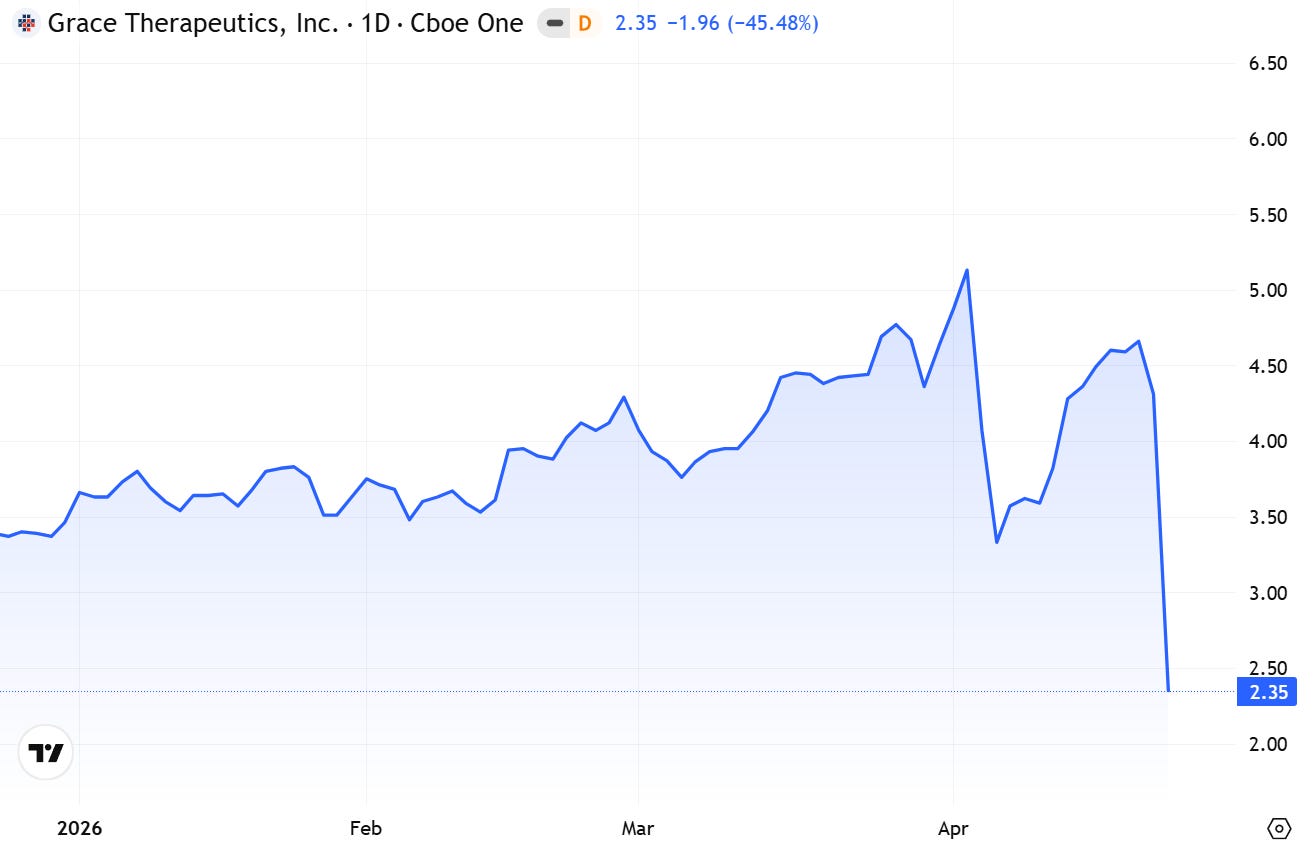
Can GRCE Remediate the CRL Before Dilution Destroys Per Share Upside
The core question is no longer whether GTx-104 works but whether Grace Therapeutics can solve a regulatory execution problem faster than capital markets force them into value destructive financing. The FDA’s CRL explicitly cited CMC issues along with non clinical items while not requesting additional clinical data which keeps the biological and efficacy foundation intact.
That combination creates a very specific setup. This is not a science risk anymore. It is a race between operational remediation and financial runway. Whether the equity works from here depends on how those two timelines intersect.
The first variable is the true scope of remediation. On paper the issues look fixable. Packaging leachables data is often a solvable analytical problem and non clinical toxicology risk assessments can sometimes be addressed through modeling bridging or literature supported justification rather than new animal work. Those two items alone would normally point toward a relatively contained fix. The complication is the inclusion of manufacturing deficiencies at the contract manufacturing organization. This is the pivot point for the entire thesis because CMO issues can range from narrow product specific documentation gaps to systemic quality failures at the facility level. If the deficiencies are narrow then remediation can proceed through targeted corrective actions and updated documentation. If they are systemic then the timeline becomes dependent on facility wide remediation and potentially a re inspection which is outside the company’s direct control and often unpredictable.
The second variable is regulatory classification of the resubmission. After the Type A meeting the FDA will determine whether the resubmission is Class 1 or Class 2. This is critical because it defines the review clock rather than just the fix itself. A Class 1 resubmission implies that the FDA views the fixes as limited and does not require substantial new data which leads to a two month review cycle. That outcome would strongly support a contained issue set and would allow the company to move back toward an approval window without a long capital gap. A Class 2 resubmission implies more substantial work such as new data packages stability updates or manufacturing related verification which extends the review cycle to six months and typically signals higher execution risk. Given that CMO deficiencies were explicitly cited the base case risk leans toward Class 2 until proven otherwise.
Disclaimer, Disclosure, Conflicts & Copyright Notice
This publication has been prepared solely for informational and educational purposes by Alpha Talon Investment Research (“Alpha Talon”). The views expressed herein represent the author’s independent analysis and opinions as of the date of writing and may change without notice. This material does not constitute investment advice, financial advice, legal advice, tax advice, or a recommendation to buy, sell, or hold any security, derivative, or financial instrument. Nothing contained in this document should be construed as an offer to sell or a solicitation to buy any securities.
Investing in securities involves significant risk, including the possible loss of principal. Equity investments may fluctuate in price, sometimes dramatically. Securities in the consumer discretionary and staples sector—such as those discussed herein—are subject to heightened levels of consumer, macroeconomics, competitive, and operational risk. Forward-looking statements, projections, price targets, valuation scenarios, and estimates included in this report are inherently speculative, based on numerous assumptions, and may differ materially from actual outcomes. Past performance is not indicative of future results.
This material has not been prepared in accordance with the legal requirements designed to promote the independence of investment research produced by broker-dealers or regulated financial institutions. This document is not a research report under FINRA, SEC, FCA, or MiFID II definitions. It has not been reviewed, endorsed, or approved by any regulatory authority, including FINRA, the SEC, or any similar body. Alpha Talon is not a registered investment adviser, broker-dealer, or financial institution under SFC or MPFA.
Readers should conduct independent research and due diligence before making any investment decision. You should consult a licensed investment adviser, registered financial professional, tax specialist, or attorney regarding your specific financial situation and risk tolerance. Nothing in this publication establishes any fiduciary relationship, advisory relationship, or obligation on the part of the author or Alpha Talon toward any reader.
The author and affiliated accounts may hold long or short positions in the securities and financial instruments discussed in this report and may trade in them before, during, or after publication without further notice. These positions may be contrary to the views expressed herein. The author does not receive compensation from the issuers of any securities mentioned. Alpha Talon does not have investment banking relationships, commercial relationships, consulting arrangements, or compensation agreements with the companies discussed in this document.
No part of the author’s compensation is directly or indirectly related to the specific recommendations, analyses, or opinions expressed in this report.
All investments involve risk, including loss of principal. Certain securities discussed may be speculative or volatile and may not be suitable for all investors. Clinical trial failures, regulatory decisions, market conditions, macroeconomic shifts, geopolitical developments, and competitive pressures can significantly impact the securities analyzed. This information is provided “as is,” without warranty of any kind, express or implied.
Securities mentioned herein are not guaranteed, not insured, and not protected by SIPC except as applicable for brokerage custody, and are not obligations of, or guaranteed by, any bank or government agency.
Alpha Talon, its author(s), and affiliates expressly disclaim all liability for errors, omissions, or any direct, indirect, incidental, or consequential losses arising from the use of this material. Use of the information is at the reader’s sole risk.
This material may not be distributed or used in any jurisdiction where such use or distribution would be contrary to local law or regulation. Readers are responsible for complying with applicable securities laws.