
The Beijing Reset: Pomp, Pledges, and Potential Guardrails
Pageantry for Beijing. Promises for Washington. Uncertainty for the rest of us.

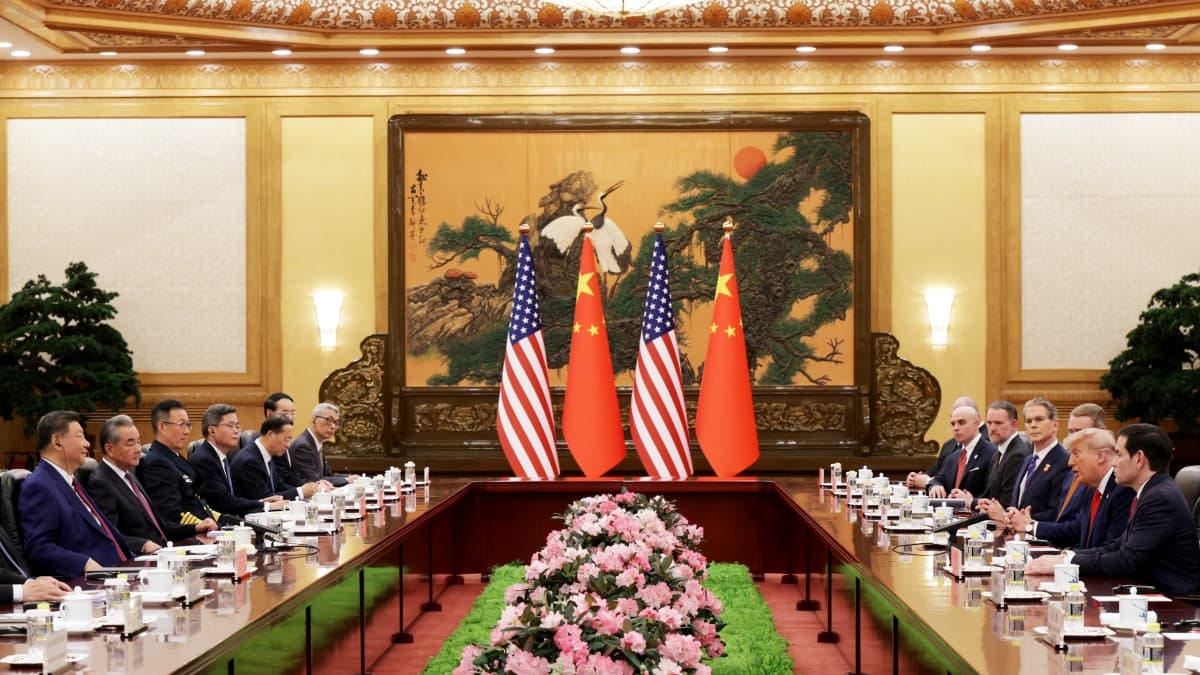
In a carefully staged two-day visit to Beijing, President Donald Trump and Chinese leader Xi Jinping framed a “strategic stability” reset — heavy on ceremony and headlines about potential purchases, light on immediate, verifiable policy breakthroughs. The meeting clarified mutual red lines (especially Taiwan), opened working-level channels, and left most concrete outcomes to be negotiated by follow-up teams.
This summit came at an inflection point: U.S.–China ties had been strained by years of tariffs, technology competition, supply-chain decoupling efforts, rising strategic mistrust, and a war in the Middle East that touched both countries’ security interests. A face-to-face between Trump and Xi matters because top-level meetings can:
Reset risk management between two nuclear-armed powers
Set practical guardrails for competition (communications, crisis-management channels)
Shift market expectations about trade and commercial flows
Both sides used the summit to shape narratives — Beijing to signal stability, Washington to tout wins for American businesses and farmers — even when the underlying details remained unfinished.
The visit in brief
Day 1 — Arrival, welcome ceremony, first talks
Arrival and business delegation: Trump landed in Beijing accompanied by a high‑profile business delegation — described by reporting as “a dozen” corporate leaders, including Tesla’s Elon Musk and Nvidia’s Jensen Huang — a deliberate signal that trade and commercial ties were part of the trip’s focus.
Grand welcome and optics: Beijing staged elaborate ceremony — honor guard, bands, flag‑waving and visual pageantry — to control the optics and project respect and seriousness. The choreography reinforced China’s aim to set the tone.
Bilateral meeting and first readouts: Trump and Xi held formal bilateral talks focused on the broad framework of restarting cooperative ties. Chinese readouts emphasized building a “constructive China–U.S. relationship of strategic stability”; the U.S. readout highlighted business opportunities and tentative commercial commitments that Beijing did not immediately confirm.
State banquet and diplomacy over dinner: The leaders attended a state banquet with formal toasts and ceremonial exchanges. Observers noted the heavy use of hospitality and personal diplomacy to reinforce rapport.
Working‑level preparation: Trade envoys and senior officials had preparatory meetings (including a presummit session in South Korea led by U.S. Treasury Secretary Scott Bessent and China’s Vice Premier He Lifeng), producing “balanced and positive” outcomes that set the stage for leaders’ talks but left details for follow‑up teams.
Day 2 — Zhongnanhai, garden diplomacy, working lunch, follow‑up architecture
Rare Zhongnanhai visit and garden tour: Xi hosted Trump at Zhongnanhai (China’s central leadership compound) and the leaders toured the gardens — a symbolic, highly unusual invitation that signals China’s intent to show hospitality and to cement personal ties. The garden walk and shared remarks were high‑profile optics of mutual respect.
Working lunch and public exchanges: At the working lunch and subsequent smaller meetings, the two leaders reiterated themes from the formal talks while giving press lines intended for domestic audiences (Trump emphasizing “fantastic” trade prospects; Xi stressing stability and managed competition).
Announced follow‑up mechanisms: Both sides agreed to set up trade and investment councils/working groups to negotiate specifics on market access, agriculture, tariffs and investment — moving many potential “deliverables” from summit rhetoric into bureaucratic negotiation channels.
No immediate, legally binding contracts: Trump publicly described likely Chinese purchases (Boeing jets, soybeans, oil) and even mentioned an order number in press remarks; Beijing’s formal statements were circumspect and emphasized continued negotiation rather than confirming immediate orders. Past practice and official Chinese readouts suggested these would be worked out and formalized later, if at all.
Major topics covered in meetings and readouts
Taiwan: Xi issued a blunt warning that Taiwan is “the most important issue” in bilateral ties and that mishandling it could jeopardize U.S.–China relations; Trump publicly declined to make new commitments, saying he “didn’t talk about” specific defense commitments, while senior U.S. officials reiterated existing U.S. policy. Taiwan remained the highest‑stakes political flashpoint.
Trade, agriculture and industry: China signaled interest in expanding purchases of U.S. agricultural goods and (reportedly) oil; the sides discussed easing some market access frictions and creating reciprocal tariff frameworks, but concrete tariff rollbacks or binding purchase contracts were not finalized at the summit.
Security and the Middle East: The war in Iran (and related regional security concerns) featured in discussions. Both leaders agreed in principle on preventing Iran from obtaining nuclear weapons and emphasized keeping the Strait of Hormuz open; they signaled a desire for better diplomatic and military communications to reduce miscalculation.
Tech, AI, rare earths and supply chains: The agenda touched on technology governance (AI), critical minerals/rare‑earths and supply‑chain issues; China framed future cooperation and “measured competition,” while the U.S. sought safeguards on technology transfer and supply‑chain resilience. Detailed tech commitments were not announced.
Fentanyl and transnational crime: Trump pressed China on curbing fentanyl precursor flows; Beijing acknowledged the concern and pledged cooperation in principle, but operational details and metrics were left for further work.
Who was there (high level)
U.S. side: President Trump, senior White House advisers, and a business delegation of leading tech, finance, industrial and defense CEOs (e.g., Elon Musk, Jensen Huang…etc) plus senior officials handling trade and finance issues. Trade envoys and Treasury officials conducted parallel preparatory meetings.
Chinese side: President Xi Jinping, senior Party and state officials, diplomatic and economic ministers, Vice Premier He Lifeng for economic talks/working groups, and CEOs (e.g., Lei Jun from Xiaomi…etc). China’s public diplomacy apparatus ran ceremonies and official readouts.
The leaders presented a strategic framework rather than a formal treaty. Xi Jinping and Donald Trump described the meeting as establishing a cooperative approach aimed at greater strategic stability between their countries. That language matters because it resets tone at the highest level and signals an intention to manage competition and reduce the risk of miscalculation. At the same time, this kind of framework is political in nature and does not create legally binding obligations. Its practical force depends entirely on the agencies and ministries that translate high level language into concrete policies and enforceable measures, so follow up work will determine whether the framework produces lasting change.
Both governments announced the creation of working groups and councils to carry negotiations forward. The stated plan calls for trade and investment councils and for smaller working teams to negotiate details such as market access, agricultural purchases, and tariff adjustments. Those bodies will staff out technical terms, compliance mechanisms, timelines, and verification steps. Because these discussions move through bureaucratic channels, solutions that sound simple at the leaders level will often require months of drafting, legal review, regulatory approvals, and interagency coordination before they are implemented.
Public commercial pledges and private confirmations diverged during and after the meetings. President Trump publicly described large prospective purchases by China, citing examples such as Boeing aircraft, soybeans, and energy supplies and calling the visit a source of significant business opportunities. Beijing’s official readouts were more cautious, framing the outcome as a willingness to cooperate and to negotiate rather than as an immediate set of signed orders. Historically, leaders meetings between Washington and Beijing have often been used to set parameters and political intent while leaving the technical and contractual steps to later negotiations. For companies and farmers, that means bold presidential statements should be treated as indications of intent until counterparties issue formal purchase contracts or regulatory approvals are published.
Immediate market effects are therefore likely to be limited. Markets and affected industries require confirmable contracts, export licences, customs clearances, and, in some cases, legislative or regulatory changes before trade flows actually shift. Announcements that signal future cooperation can move sentiment, but they do not on their own create sustained order books or alter tariff regimes. Observers and participants should watch for formal government confirmations, public contract filings by companies, documented tariff or quota changes, and official timelines from the newly announced councils and working teams. Those tangible steps will be the true indicators that summit language has been converted into enforceable outcomes.
Taiwan: the most sensitive line
Xi Jinping spoke plainly about Taiwan, calling the island the most important issue in relations between the United States and China and warning that mishandling it could put bilateral ties in great jeopardy. His language was intended to draw a clear boundary and to signal Beijing’s intolerance of moves it regards as steps toward formal independence. The message was both public and political, aimed at shaping American decision making and domestic audiences in China.
Beijing’s immediate objective in emphasizing Taiwan is to secure explicit assurances that the United States will not take actions Beijing views as provocative. Those actions include formal diplomatic recognition of independence, changes to the United States posture that would make Taiwan’s separation more tenable, and approvals of major systems that Beijing considers to alter the island’s military balance. Chinese leaders often link concessions on Taiwan to broader strategic and commercial cooperation, so pressure on this issue can be used as leverage in other areas of the relationship.
The United States continues to operate under a policy often described as strategic ambiguity. Under that policy Washington recognizes the government in Beijing diplomatically while maintaining unofficial ties with Taiwan and continuing to provide defensive arms consistent with the Taiwan Relations Act. At the summit President Trump declined to give a new public commitment about specific future actions and said he would not discuss the matter in detail. Senior U.S. officials have reiterated that official U.S. policy remains unchanged even as both sides look for ways to reduce the risk of confrontation.
That unresolved tension matters because it is a potential flash point between two major powers with deep economic links and significant military capabilities. If either side misreads the other’s intent or if rapid changes occur on the ground, the result could be dangerous escalation. Military exercises, high level visits, large arms sales, or abrupt shifts in rhetoric all have the potential to increase the risk of incidents at sea or in the air that could spiral into a wider crisis. At the same time, China’s efforts to pressure Taiwan economically or diplomatically can reshape the island’s international space without open conflict.
In practical terms, the moves to watch now include decisions on pending arms sales, any explicit policy statements that alter the language of U.S. commitments, visible changes in military activity around Taiwan, and signals from allied capitals. Congressional action, Taiwanese policy choices, and private diplomatic communications behind the scenes will also be important. The summit did not resolve the fundamental dispute, so each side’s next steps will determine whether recent talk of managed stability translates into measures that reduce risk or whether fault lines widen again.
For the moment the meeting preserved an uneasy status quo. That outcome reduces immediate public confrontation but leaves the substance to working groups and lower level negotiations. Managing the Taiwan question will require sustained diplomacy, clear crisis communications, and coordination with partners to preserve deterrence while avoiding actions that might be interpreted as irreversible changes in the island’s status.
Tariffs and market access
The summit reiterated both sides’ interest in expanding market access and negotiating trade and investment frameworks, but it did not remove the tariffs that have been central to recent U.S.–China economic friction. Those tariffs remain a major policy lever for the U.S. and a bargaining chip in any future negotiations, so any changes will require follow‑up work in trade ministries, congressional buy‑in in Washington, and agreement on reciprocal measures from Beijing. Because tariffs are statutory or administratively maintained, they cannot be reversed by a leaders’ handshake alone; instead, they must be translated into specific commitments, timetables, and implementing actions such as tariff schedules, regulatory changes, or new procurement rules. Market participants should treat summit language as a signal of intent rather than proof of immediate policy change.
Agriculture and energy
China signaled interest in increasing purchases of U.S. agricultural goods and in diversifying energy suppliers, which could create near‑term opportunities for U.S. farmers and oil exporters. President Trump highlighted possible large-scale purchases of soybeans and aircraft, and the conversation included references to greater Chinese purchases of U.S. oil. Beijing, however, did not immediately confirm firm, signed contracts at the summit; historically, China often moves from verbal commitments and symbolic announcements at leader meetings to more detailed, conditional procurement agreements negotiated through state agencies and commercial actors. Any actual uptick in exports will depend on final contractual details, logistics, financing and customs approvals, and in some cases domestic Chinese policy choices about subsidies or quotas.
Technology, rare earths, and artificial intelligence
Leaders discussed strategic technology issues, supply chains for critical minerals and rare earths, and the governance and competition dimensions of artificial intelligence. Durable agreements in these areas are inherently complex because they touch domestic industrial policy, national security controls, export licensing, subsidy regimes, technology standards, and intellectual property protections. For example, export controls on advanced semiconductors and dual‑use technologies are administered through regulatory processes that require interagency coordination and, in the U.S., often congressional engagement. Rare‑earth value chains are another area of strategic vulnerability: China still dominates much of the mining, processing and refining capacity, so any effort by the U.S. or its partners to secure alternative supplies will require sustained investments in mining, processing, and recycling, together with incentives and regulatory changes. AI governance conversations can cover anything from common safety standards and interoperability of risk assessments to limits on certain military or surveillance uses; meaningful cooperation there would require parallel domestic rulemaking and multilateral standards work.
Security, the Middle East, and crisis communications
They spoke about the conflict in Iran and broader regional security, and they agreed on the basic goal of keeping vital sea lanes such as the Strait of Hormuz open for commercial traffic and energy shipments. Both sides also restated that they do not want Iran to obtain nuclear weapons. Those shared statements matter because they reduce the chance that either capital will make abrupt moves that could suddenly raise the risk of wider confrontation. Readouts noted the discussions and these mutual aims.
Equally important was their interest in strengthening diplomatic and military communication channels. In practical terms this means establishing reliable methods to exchange information quickly when tensions rise, to notify each other about planned operations near sensitive areas, and to resolve misunderstandings before they escalate into armed clashes. If these mechanisms are actually put into use, they can prevent accidents at sea and limit the chance that a local incident spirals into a broader confrontation.
Operationalizing such channels typically involves several mutually reinforcing steps. First, secure hotlines and designated points of contact need to be set up between foreign ministries and between defense establishments. Second, liaison officers or teams can be exchanged or colocated for routine information sharing. Third, agreed protocols for naval and air encounters must be codified so that ships and aircraft know how to behave when they come into proximity. Fourth, confidence building practices such as periodic exercises, tabletop crisis simulations, and shared situational reporting can create habit and predictability between operators.
There are clear benefits if these measures are implemented in good faith. Faster, clearer communications reduce uncertainty and lower the risk of miscalculation. Coordinated reporting on threats to commercial shipping can help protect global trade and energy markets. Joint crisis-management procedures make it easier for both sides to calibrate their responses in a way that preserves room for diplomacy.
At the same time, there are significant obstacles. Deep strategic mistrust persists, and domestic political pressures in both countries can limit flexibility. Differences in threat perceptions and in how each side defines its red lines may slow agreement on concrete protocols. Taiwan and other bilateral tensions will complicate efforts to expand military trust. Allies and partners, especially those in the Indo Pacific and the Middle East, will also demand consultations and reassurances, making any simple bilateral arrangement more complex in practice.
To be meaningful, the summit commitments must move from statements to written agreements and then to routine practice. That will require technical working groups, timelines, and verification measures so that each side can be confident the other is following the rules.
The role of optics and personal diplomacy
The ceremonial elements of the trip did more than create attractive photo opportunities; they were instruments of influence. Elaborate receptions, carefully staged tours, and a state banquet all operate as rituals that structure interactions and set expectations. Rituals reduce uncertainty, encourage reciprocal warmth, and make leaders more likely to favor conciliatory language in front of cameras. For a host nation, such pageantry also signals control and prestige, reminding visitors and domestic audiences that the host sets the pace and tone of the encounter.
China invests in theatrical diplomacy because performance creates leverage. Public displays of respect and hospitality can prompt reciprocal gestures from guests, and those gestures can then be amplified by state and international media to shape narratives. When leaders exchange smiles, gifts, and tours of historic sites, those moments become shorthand for mutual goodwill. That shorthand can be useful for advancing broad frameworks or opening a pathway to later technical negotiations, but it is not a substitute for written agreements or enforceable commitments.
For President Trump, whose political method has long relied on personal rapport and headline moments, the ceremonial environment was congenial. Direct, face to face exchanges allow him to convert interpersonal chemistry into public claims about progress and deliverables. That approach can accelerate attention and create momentum, particularly when business delegations travel with the president and signal commercial possibilities. At the same time, personal chemistry cannot by itself overcome bureaucratic frictions, regulatory hurdles, or competing domestic political pressures in either capital.
Analysts caution that striking images and warm words can mask an absence of substantive follow through. Leaders can return home with vivid photographs and broad statements while the negotiating teams still haggle over details in back offices. This means that short term market reactions or political headlines may overvalue the significance of the summit if observers do not wait for formal contracts, official statements, or implemented policy changes. Pageantry can therefore create a false sense of accomplishment unless it is matched by clear, verifiable steps.
Finally, the power of optics is also a risk. When a leader appears to seek public validation from a foreign counterpart, domestic critics may interpret that as weakness. Conversely, if a host uses grandeur to underscore the guest’s dependence, the guest may lose leverage in later bargaining. For policymakers and analysts, the most useful response is to treat theatrical diplomacy as an opening move. Observe the rituals and note the signals they send, but focus verification efforts on written agreements, announced timelines, and operational mechanisms that translate the summit’s rhetoric into enforceable actions.
Reactions and expert takes
U.S. political reaction was mixed. Some business leaders and trade advocates praised the warmer tone and the prospect of new commercial opportunities for American firms and farmers. They pointed to the presence of major corporate executives on the trip and the public references to potential purchases as reasons to be cautiously optimistic about export growth and renewed market access. At the same time, members of Congress from both parties raised questions about the substance behind those announcements. Critics argued that the administration offered a parade of promises without presenting verifiable, written commitments, and they worried that optimistic public claims could be premature. Others emphasized that pursuing bilateral deals with Beijing without stronger coordination with U.S. allies risks undercutting long term strategic leverage and could create divisions that Beijing might exploit.
Analysts described the summit as a tactical win for Beijing because of the optics it achieved. Chinese officials successfully staged elaborate ceremonies and controlled the narrative to emphasize a message of stability and reciprocity, which plays well domestically and internationally. Observers noted that those optics serve multiple goals for Beijing. They reinforce the image of Xi Jinping as a statesman able to manage relations with a dominant global rival, they project confidence to domestic audiences, and they create a diplomatic environment in which China can steer follow up negotiations on terms that favor its interests.
Many experts also concluded that the summit did not deliver strategic concessions on China’s highest priorities, most notably Taiwan. Beijing used the meeting to restate its core demands regarding Taiwan and to warn against steps it considers provocative. Analysts observed that while China secured high profile public signaling from the leader of the United States, it did not extract any clear, binding U.S. commitments that would alter the status quo. That gap matters because Taiwan remains the most volatile flashpoint in the relationship and because any durable change in U.S. policy would require legislative, bureaucratic, and coalition support that goes beyond a leaders’ photo op.
Experts advising policymakers recommended a sequence of practical next steps to convert talk into verifiable progress. They urged fast but careful follow up by working groups that produce publicly documented deliverables, robust verification mechanisms for any trade or purchase commitments, and renewed engagement with allies to rebuild a unified approach to China on issues such as critical minerals, technology controls, and security guarantees. Many emphasized that strategic stability will be more durable if it is grounded in institutional arrangements and multilateral coordination rather than in transient bilateral pageantry.
What does it mean for financial market?
The summit reduced headline geopolitical risk and improved sentiment temporarily, but it produced few verifiable, near‑term commitments. Markets will therefore trade the meeting as a signaling event rather than as a source of immediate, durable policy change. That creates an environment where risk assets can rally on positive headlines, but volatility will remain elevated until concrete contracts, tariff changes, or regulatory confirmations appear.
Immediate impact (days to weeks)
Risk appetite may edge higher on optics and rhetoric, helping cyclical and China‑exposed stocks.
Safe havens such as U.S. Treasuries and gold may soften, while the dollar could weaken modestly.
Expect headline-driven swings: equities may spike on optimistic claims and reverse quickly if confirmations do not follow.
Near term (weeks to months)
Markets will reprice based on implementation. Confirmed purchases (aircraft, agriculture, energy) or formal working‑group deliverables will produce more durable sector moves.
Sectors with direct China exposure will lead rotations; semiconductor, aerospace, commodity, and agricultural prices will respond to verified flow changes.
Persisting ambiguity on Taiwan and export controls keeps downside tail risk alive and keeps premiums in defense and risk‑off assets.
Medium to long term (months to years)
Structural outcomes matter most. Policies on export controls, critical minerals, and allied coordination will determine returns for tech, defense, and resource sectors over time.
A genuine, enforceable framework or multilateral coordination would lower structural risk and support sustained investment flows; a failure to institutionalize agreements will maintain a regime of episodic shocks.
Sector implications
Aerospace and heavy manufacturing benefit if large aircraft orders are confirmed.
Agriculture and soft commodities react to any verified purchase commitments.
Energy markets move on confirmed changes in Chinese oil procurement.
Technology and semiconductors remain sensitive to export‑control policy and supply‑chain reshoring.
Defense and security stocks price in Taiwan‑related tail risk even as diplomatic channels reduce short‑term escalation probability.
Three market scenarios to consider
Optimistic execution: Confirmations of purchases and tariff easing drive a sustained risk‑on cycle and higher yields.
Status‑quo: Readouts and councils are announced but implementation stalls, producing muted gains and elevated volatility.
Adverse escalation: Taiwan or other flashpoints trigger risk‑off flows; equities fall, Treasuries and gold rally, and defense names spike.
Actionable indicators to watch
Official contract confirmations and government procurement notices.
Statements and timelines from the announced trade and investment councils.
U.S. decisions on pending Taiwan arms sales and congressional commentary.
Volatility measures including the VIX, CDS spreads on China exposure, and sectoral implied volatilities.
Commodity moves in soybeans, oil, copper and rare earths; RMB flows and FX reserves adjustments.
The summit is constructive for sentiment but not a substitute for verifiable, enforceable agreements. Investors should treat it as a signal of intent and place greater weight on follow‑up confirmations, working‑group deliverables and Taiwan policy moves when adjusting exposures.
***End of This Edition of Power, Policy & Markets***